How to Do Office Lighting the Right Way
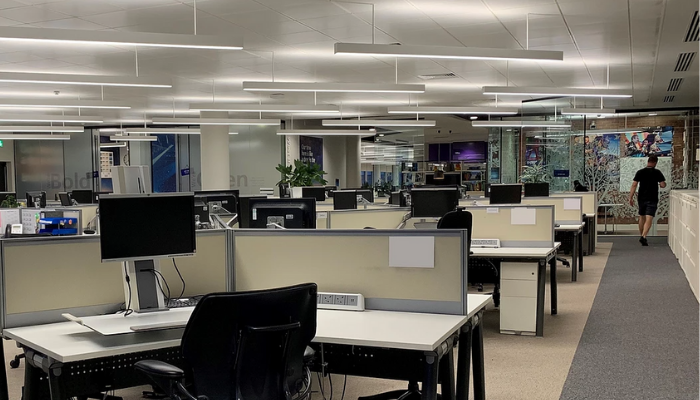
Great office lighting has never mattered more. By great, we mean inspirational workplace lighting: schemes that deliver enough light for the task, but also use light to motivate people and support their physical and emotional wellbeing.
A 2018 Fellowes survey found that 81% of UK office workers spend between four and nine hours a day at their desk — around 67 sedentary days per person each year. With most of our time spent indoors under artificial light, the line between day and night has blurred. Research is clear: light isn't only for seeing; it governs how our bodies work, biologically and psychologically.
The right balance of daylight and well-considered artificial lighting improves satisfaction and productivity. Here are five steps to get there.
1. Light to boost productivity
Research from Germany's Fraunhofer Institute for Industrial Engineering found that in companies with a high standard of interior design, productivity can rise by up to 36%. The Light Right Consortium's study on office lighting found 91% of participants preferred a direct/indirect scheme with well-lit vertical surfaces — and that individually controllable desk lighting made people more motivated and accurate.
Good lighting is about more than lux levels and luminance limits. Surface reflectance, interior colours and luminaire distribution all play a part, especially where recessed panels form the primary scheme.
Our recommendation: combine recessed, surface and suspended luminaires with downlights, and play with direct and indirect light.
2. Think 3% daylight
Bring lighting designers in early on new builds. Guidance suggests around 3% daylight should reach the working area. Daylight gives a space emotional quality, so place desks near windows where possible — with blinds to control screen reflections. LG7 now leaves screen-reflection limits to the designer's discretion, so apply them where they are relevant to the space.
Our recommendation: make the most of daylight to cut artificial lighting demand and boost wellbeing.
3. Provide choice and control
Light affects our circadian rhythm. Cooler, blue-rich white light keeps us alert and focused; warmer colour temperatures later in the day help the body wind down.
Our recommendation: blend 4000K with 3000K, or give users dynamic controls to choose the right light at the right time.
4. Light for people, not just tasks
Poorly lit workplaces can feel small and claustrophobic. To create comfort and spark innovation:
- Adapt lighting to time of day, season and individual needs.
- Illuminate large vertical surfaces to create depth and give the eyes a resting point.
- Light the ceiling as well as the task area.
Our recommendation: build flexibility in with lighting controls — dimming and tunable white make a real difference to comfort.
5. Energy still matters
Lighting is a major part of a building's energy demand. Careful selection of luminaires and light sources, paired with sensors and controls, reduces consumption without compromising quality.
Our recommendation: speak to the people who will use the space early on, so the scheme delivers exactly the light they need with minimal energy.
As working patterns change, lighting must respond — so design schemes to adapt. Want to talk workplace lighting? Contact the EOS team.
Interested in learning more?
Get in touch with our team to discuss how EOS can support your next project.
Contact Us