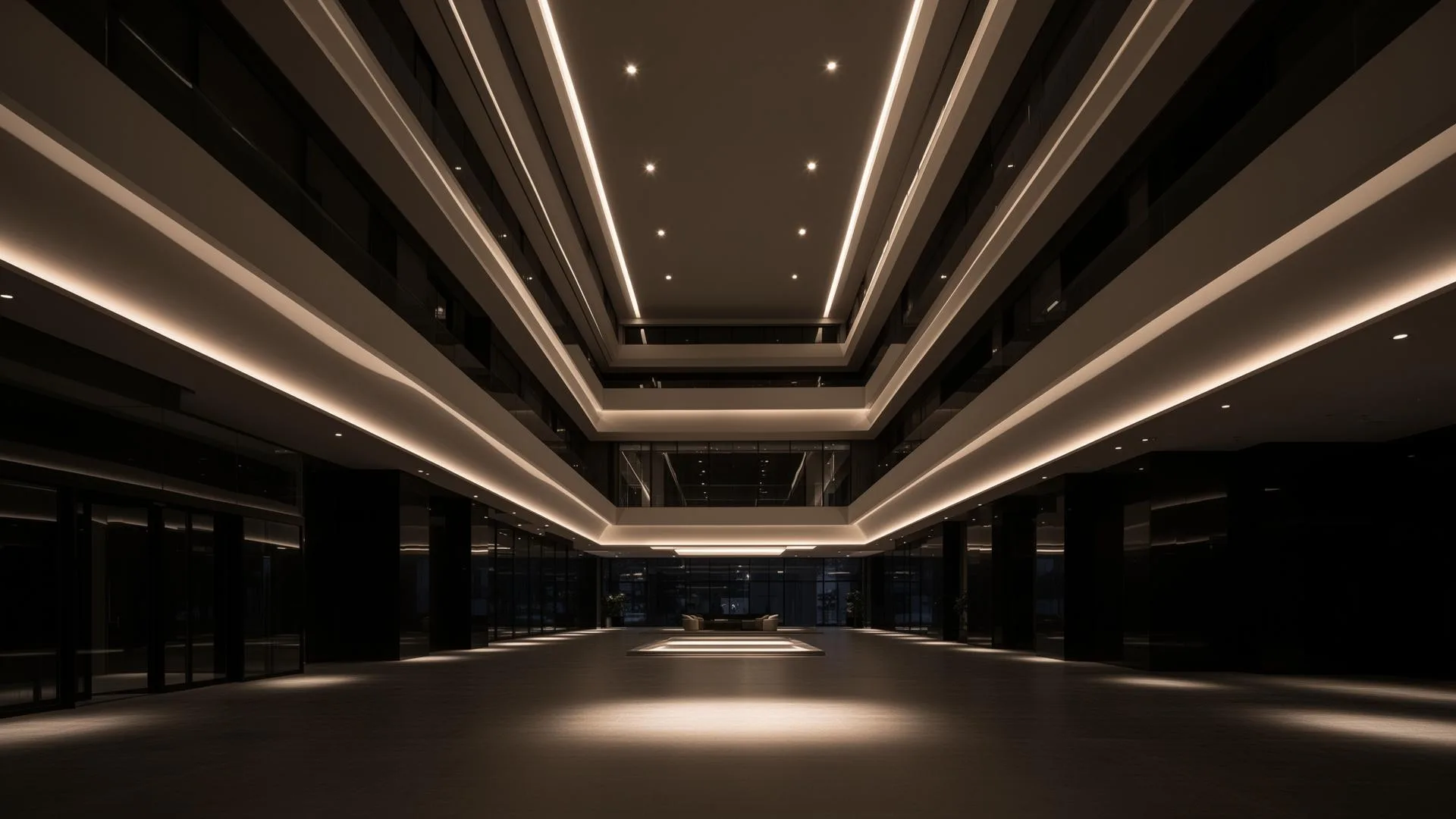
Understanding Beam Angle
Beam angle is measured in degrees. A narrow beam concentrates light into a tight cone, creating higher intensity over a smaller area. A wide beam spreads light broadly, creating lower intensity but more uniform coverage.
Common beam angle categories:
• Narrow spot — 8°–15°. Intense, focused beam for accent lighting, highlighting architectural features or artwork. • Spot — 15°–25°. Tighter focus for retail display lighting, track spots and feature illumination. • Medium flood — 25°–40°. General-purpose beam suitable for downlights, recessed luminaires and task lighting. • Flood — 40°–60°. Wide distribution for ambient room lighting, corridors and large open areas. • Wide flood — 60°–120°. Very broad spread for wall washing, cove lighting and uniform area illumination.
Beam Angle and Spacing
Beam angle directly determines how far apart luminaires can be spaced while maintaining uniform illuminance. Narrow beams require closer spacing to avoid dark spots between fittings. Wide beams can be spaced further apart but deliver lower peak intensity.
Lighting designers use the spacing-to-height ratio (SHR) — the ratio of luminaire spacing to mounting height — to calculate optimal layouts. A luminaire with a 60° beam angle at 2.8m mounting height might have an SHR of 1.5, meaning fittings can be spaced up to 4.2m apart while maintaining acceptable uniformity.
Choosing the Right Beam Angle
• Offices — medium flood (40°–60°) for uniform task lighting across desks • Corridors — wide flood (60°+) for even coverage with fewer fittings • Retail — spot (15°–25°) for merchandise highlighting, medium flood for ambient • Warehouses — medium (40°–60°) from high-bay luminaires to balance coverage and intensity • Exterior — narrow (8°–15°) for façade uplighting, flood (40°–60°) for car parks and pathways • Architectural — narrow to medium for accent features, wide for wall washing
Many EOS luminaires offer interchangeable optics or adjustable beam angles, giving specifiers flexibility to fine-tune the lighting scheme during commissioning.
More Guides
What is a Lumen?
A lumen (lm) is the SI unit of luminous flux — it measures the total quantity of…
What is Illuminance?
Illuminance is the measure of how much luminous flux (light) falls on a given su…
What is UGR?
UGR — Unified Glare Rating — is a standardised metric that quantifies the degree…
What is Colour Temperature?
Colour temperature describes the appearance of white light emitted by a source, …
What is CRI?
CRI — Colour Rendering Index — measures how accurately a light source reveals th…
What is Luminous Efficacy?
Luminous efficacy measures how efficiently a light source converts electrical en…