What is a Lux?
Lux (lx) is the SI unit of illuminance, measuring the amount of luminous flux (light) per unit area. One lux equals one lumen per square metre. Unlike lumens (which measure the total light output of a source), lux measures how much light actually arrives at the working surface — the desk, floor, production line or display shelf.
For lighting design, lux levels are specified as 'maintained illuminance' (Em) — the minimum average illuminance on the reference surface after accounting for lamp depreciation, dirt accumulation and maintenance intervals. This ensures that the lighting scheme meets the required standard throughout its operational life, not just on day one.
Office Lux Levels
BS EN 12464-1 specifies the following maintained illuminance levels for office environments:
• General office / open plan — 500 lux • Filing, copying, circulation — 300 lux • Technical drawing — 750 lux • Conference rooms — 500 lux • Reception areas — 300 lux • Corridors, stairs — 100 lux • Archives and storage — 200 lux • Server rooms — 200 lux
Additionally, the standard specifies a maximum Unified Glare Rating (UGR) of 19 for general office areas and 16 for technical drawing, ensuring visual comfort for screen-based work.
Industrial & Warehouse Lux Levels
Industrial environments require illuminance levels tailored to the visual demands of the task:
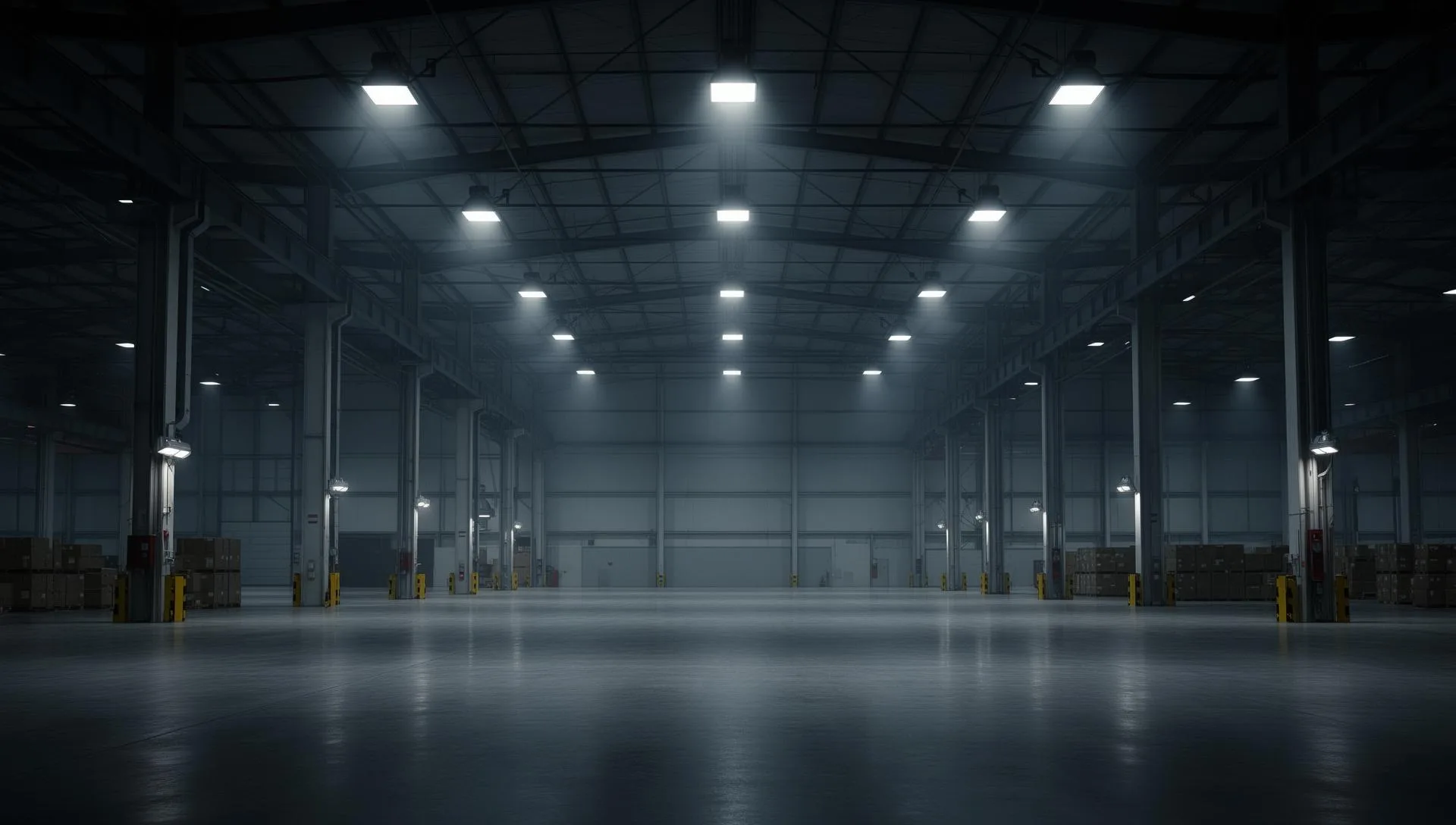
• Warehousing (general storage) — 100 lux • Packing, despatch — 300 lux • Assembly (rough) — 300 lux • Assembly (fine) — 500 lux • Inspection (general) — 500 lux • Inspection (fine detail) — 750-1000 lux • Welding — 300 lux • Machine workshops — 500 lux • Food processing — 500 lux • Cold stores — 200 lux
For warehouse racking aisles, vertical illuminance on rack faces is as important as horizontal illuminance on the floor. EOS high-bay luminaires are available with aisle-optimised optics that direct light onto vertical surfaces for accurate pick-face reading.
Education Lux Levels
CIBSE LG5 and BB93 provide specific guidance for educational environments:
• Classrooms — 300 lux (Em on desk), UGR ≤ 19 • Whiteboards / teaching walls — 500 lux (vertical illuminance) • Art rooms — 500 lux • Science laboratories — 500 lux • Lecture theatres — 500 lux • Libraries — 500 lux • Sports halls — 300 lux (recreational), 500 lux (competition) • Corridors — 100 lux • Staff rooms — 300 lux
In classrooms with interactive screens and displays, controlling glare (UGR) and avoiding reflections on screens is as critical as achieving the target lux level. EOS modular panels and linear systems are available with UGR<19 micro-prismatic optics specifically designed for education environments.
Healthcare Lux Levels
Healthcare lighting standards are defined by CIBSE LG2 and HTM 08-03:
• General wards (day) — 300 lux • General wards (night) — 5 lux (observation lighting) • Examination / treatment rooms — 1000 lux • Operating theatres (general) — 1000 lux (ambient) • Operating theatres (task) — 10,000-100,000 lux (surgical luminaire) • Corridors — 200 lux (day), 50 lux (night) • Nurses' stations — 300 lux • Consulting rooms — 500 lux • Pharmacy — 500 lux • Pathology labs — 500 lux
High colour rendering (CRI ≥ 90) is essential in clinical areas where accurate colour assessment of tissue, fluids and medications is critical. Tuneable white technology supports circadian wellbeing in ward environments.
Retail & Hospitality Lux Levels
Retail and hospitality environments balance functional illuminance with aesthetic impact:
• General retail sales areas — 300 lux • High-end retail / fashion — 500-750 lux • Supermarkets — 500 lux • Food counters — 500 lux (CRI ≥ 90 recommended) • Window displays — 1000+ lux • Hotel lobbies — 200-300 lux • Hotel rooms — 150-300 lux (variable) • Restaurants — 50-200 lux (atmosphere-dependent) • Bars — 50-100 lux • Kitchens (commercial) — 500 lux
In retail, accent lighting (3:1 to 5:1 contrast ratio with ambient) is critical for highlighting products and creating visual hierarchy. Track-mounted adjustable spots enable flexible merchandising layouts.
More Guides
IP Ratings Explained
IP (Ingress Protection) ratings classify the degree of protection a luminaire pr…
IK Ratings Explained
IK ratings classify the degree of protection a luminaire provides against mechan…
Part L Building Regulations & Lighting
Approved Document Part L of the Building Regulations sets minimum energy perform…
Emergency Lighting Testing Requirements
Emergency lighting is a life-safety system and its regular testing is a legal re…
IP Rating Guide for LED Lighting
The Ingress Protection (IP) rating is a two-digit code defined by BS EN 60529 th…
ATEX & Hazardous Area Lighting Guide
Hazardous areas — locations where flammable gases, vapours, mists or combustible…