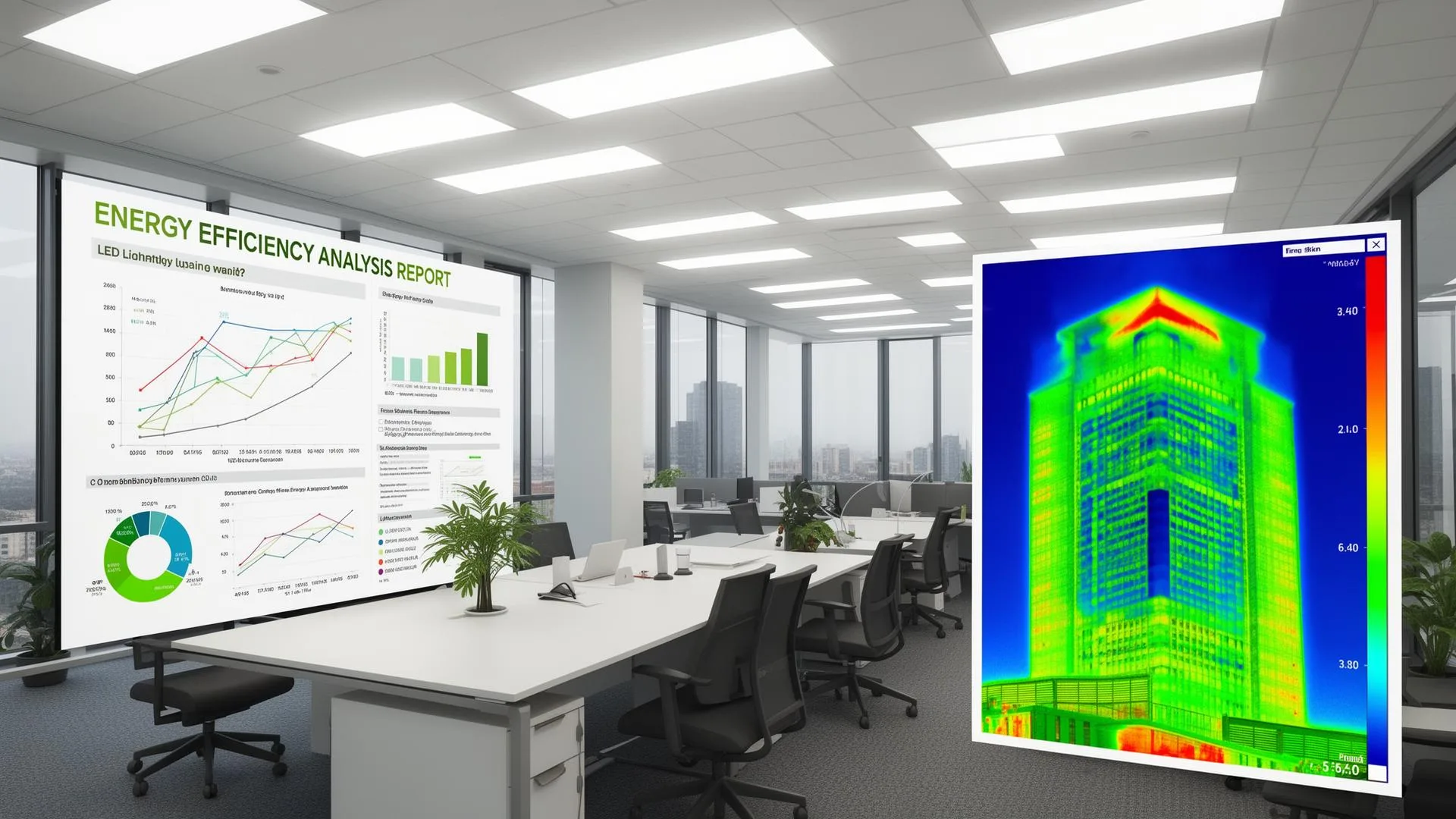
What is an EPC?
An Energy Performance Certificate assesses a building's energy efficiency based on its fixed building services — heating, cooling, ventilation, hot water, and lighting. The assessment uses the Simplified Building Energy Model (SBEM) methodology, which calculates energy consumption based on the building's construction, orientation, and installed services.
A commercial EPC is valid for 10 years and is required whenever a building is constructed, sold, or let. The certificate includes:
• An energy efficiency rating (A to G) • An environmental impact (CO₂) rating (A to G) • Recommended improvement measures with estimated cost savings
Lighting is assessed as part of the fixed building services. The type of lighting (fluorescent, LED, halogen), its efficacy (lumens per watt), and the installed controls (manual switching, occupancy sensing, daylight dimming) all directly influence the rating.
How Lighting Affects Your EPC Rating
Lighting typically accounts for 20–40% of a commercial building's regulated energy consumption. This makes it one of the largest single contributors to the EPC calculation.
The SBEM assessment considers:
• Lamp type and luminaire efficacy (lm/W) — LED luminaires at 130–160 lm/W score significantly better than T8 fluorescent (70–90 lm/W) or T5 fluorescent (90–110 lm/W)
• Lighting controls — automatic controls (presence detection, daylight dimming, time scheduling) reduce the calculated operating hours and energy consumption
• Installed power density (W/m²) — lower wattage per square metre directly reduces the lighting energy calculation
• Parasitic loads — standby power consumption of drivers, controls and emergency lighting battery charging
A building with old T8 fluorescent lighting, manual switching, and no daylight controls will score poorly. Replacing this with high-efficacy LED luminaires and DALI controls can improve the lighting component of the EPC by 2–3 rating bands.
The Impact of LED Upgrades on EPC Ratings
Real-world case studies consistently show significant EPC improvements from LED lighting upgrades:
• A typical 1990s office with T8 fluorescent lighting and manual switching: original EPC rating D or E. After LED retrofit with DALI controls: improved to B or C — a 2-band improvement from lighting alone.
• A warehouse with high-pressure sodium (HPS) high bays: original EPC rating E or F. After LED high bay replacement with absence detection: improved to C or D.
• A retail unit with halogen downlights: original EPC rating E. After LED downlight replacement: improved to C.
The key point is that lighting upgrades are typically the most cost-effective EPC improvement measure — they deliver large energy savings with relatively short payback periods (typically 2–4 years), whereas fabric improvements (insulation, glazing) involve much higher capital costs and longer payback periods.
Many EPC assessors list lighting upgrades as the number-one recommendation on certificates for older buildings.
MEES Regulations and the 2030 Target
The Minimum Energy Efficiency Standard (MEES) regulations make it unlawful to let commercial properties that fall below the minimum EPC rating:
• Since April 2018: minimum EPC rating of E for new leases • Since April 2023: minimum EPC rating of E for all existing leases (including renewals) • Proposed (government consultation): minimum EPC rating of B by 2030
Properties that fail to meet the minimum standard cannot be legally let. Landlords face fines of up to £150,000 per property for non-compliance.
The proposed uplift to EPC B by 2030 will affect a very large proportion of the UK commercial building stock. Many buildings currently rated C or D will need significant energy efficiency improvements — and lighting will be the first and most cost-effective measure in almost every case.
Building owners should act now: an LED lighting upgrade today not only reduces energy costs immediately but future-proofs the property against MEES tightening.
Related Pages
More Guides
TM66 Circular Economy Lighting
TM66 is the CIBSE Technical Memorandum that provides a standardised method for a…
LED Retrofit Guide
Converting existing lighting to LED — an LED retrofit — is a win-win on many lev…
BREEAM Lighting Credits Guide
BREEAM (Building Research Establishment Environmental Assessment Method) is the …
What is DALI Lighting?
DALI (Digital Addressable Lighting Interface) is the global industry standard fo…
Tuneable White Lighting Guide
Tuneable white (also called tuneable CCT or human centric lighting) allows the c…
Lux Levels Guide
Lux is the standard unit of illuminance — the amount of light falling on a surfa…