What is DALI Lighting?
Written by Brian Glynn, Co-founder and Director
Published 28 October 2026 · Last updated 28 October 2026
 Made in Britain member
 Member of the Institution of Lighting Professionals (ILP)
What Does DALI Stand For?
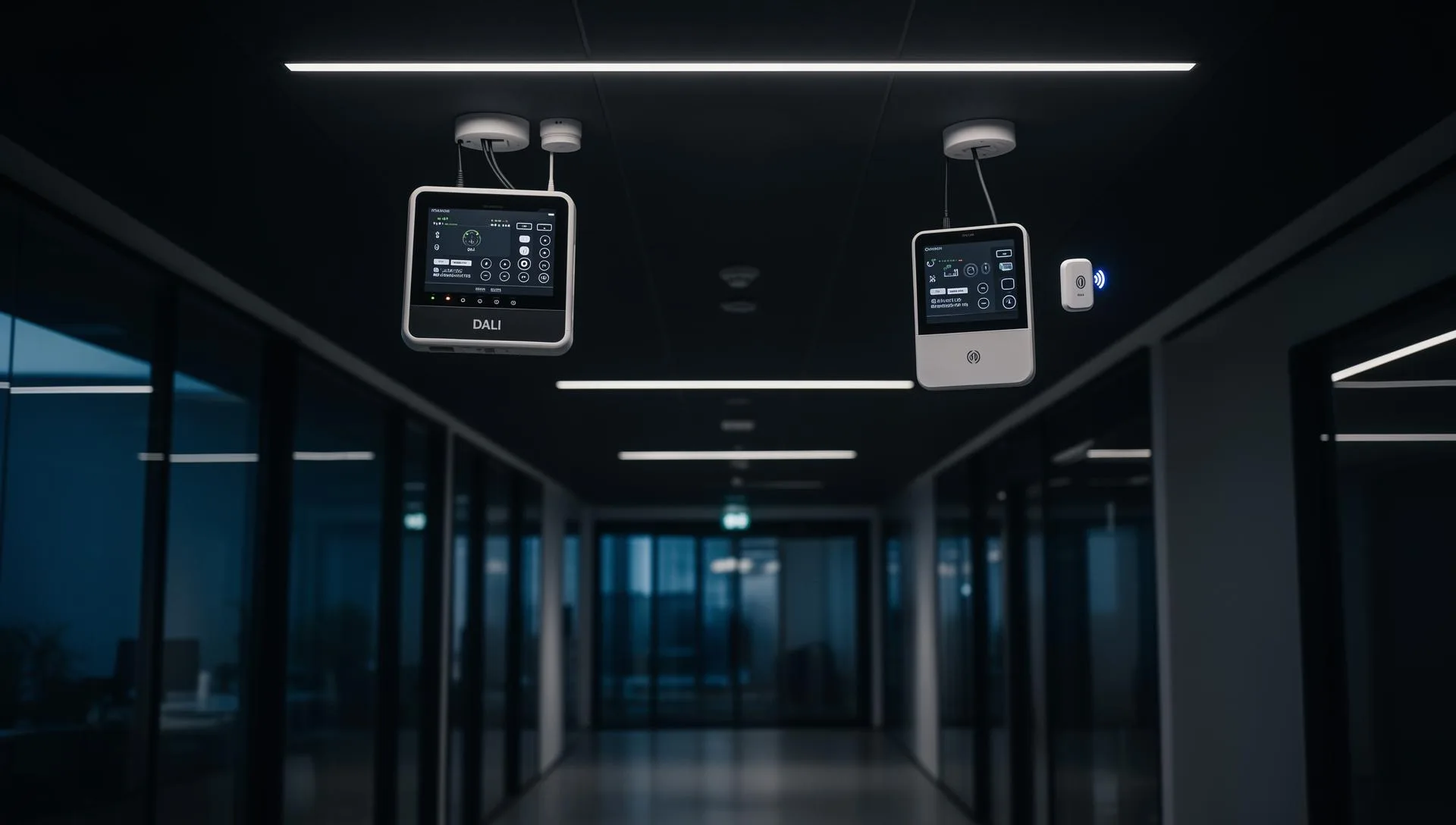
DALI stands for Digital Addressable Lighting Interface. It is an internationally standardised protocol (IEC 62386) that enables two-way digital communication between lighting control devices and individual luminaires. Unlike simple switching or 1-10V analogue dimming, DALI allows each luminaire on a circuit to be individually addressed, monitored and controlled — giving building managers precise, flexible control over every light fitting in a project.
How Does DALI Work?
A DALI system uses a dedicated two-wire control bus (polarity-free) that connects up to 64 individually addressable devices on a single DALI line. Each luminaire's DALI driver receives digital commands to dim, switch or report its status. Multiple DALI lines can be bridged via a DALI gateway or controller to manage entire buildings from a central BMS (Building Management System) or touchscreen interface.
DALI signals are low-voltage digital commands, not power signals — meaning the control wiring is separate from the mains supply. This makes DALI systems inherently safer, more flexible and easier to reconfigure than legacy analogue systems.
DALI vs DALI-2: What's the Difference?
DALI-2 is the current version of the standard, published under IEC 62386 Edition 2. The key improvements over original DALI (sometimes called DALI-1) include:
• Mandatory interoperability testing — DALI-2 devices from different manufacturers are guaranteed to work together • Standardised input devices — sensors, switches and push-buttons are now part of the standard (Part 301-304) • Improved colour control — dedicated commands for tuneable white and RGBW colour mixing • Extended diagnostic reporting — lamp failure detection, power consumption monitoring and operating hours tracking
All EOS wired control solutions are DALI-2 compliant, ensuring full interoperability across multi-brand installations.
Benefits of DALI Lighting Controls
• Individual luminaire control — dim, switch and configure every fitting independently • Scene setting — store and recall pre-programmed lighting scenes for different activities or times of day • Daylight harvesting — automatically dim luminaires near windows when natural light is sufficient • Occupancy sensing — integrate PIR or microwave sensors to switch off lights in unoccupied zones • Energy monitoring — track power consumption per luminaire for accurate carbon reporting • Future-proof flexibility — reassign groups and scenes via software without rewiring • Reduced commissioning time — digital addressing replaces complex wiring schedules
Where is DALI Used?
DALI is the default control protocol for specification-grade commercial LED lighting. Common applications include:
• Offices — desk-level dimming, daylight linking and occupancy-based switching • Healthcare — circadian lighting schedules, ward-level scene control and emergency integration • Education — classroom scene presets, corridor dimming and energy reporting for DEC compliance • Retail — zoned lighting scenes that adapt to trading hours, promotional displays and seasonal themes • Hospitality — lobby, restaurant and conference room scene management
EOS offers both wired DALI-2 and wireless Plexus control systems, giving specifiers the choice between hardwired reliability and retrofit-friendly wireless flexibility.
Need help with your project?
Talk to EOS about a design, a value engineering review or the right product.
More Guides
Tuneable White Lighting Guide
Tuneable white (also called tuneable CCT or human centric lighting) allows the c…
Wireless Lighting Controls & EOS Plexus™
Wireless lighting controls eliminate the need for dedicated control wiring, maki…
TM66 Circular Economy Lighting
TM66 is the CIBSE Technical Memorandum that provides a standardised method for a…
Lux Levels Guide
Lux is the standard unit of illuminance — the amount of light falling on a surfa…
How to Light an Office
Never has the need for great office lighting been more imperative. This guide co…
How to Light a Living Wall
Living walls — vertical greening typologies where a built structure is intention…