Why Wireless Controls?
Traditional wired lighting controls — DALI, DSI, 1-10V — require dedicated control cabling between luminaires, sensors and switches. In new-build projects this is straightforward to specify and install. But in retrofit, refurbishment and heritage environments, running new control wiring is often prohibitively expensive, disruptive or physically impossible.
Wireless controls solve this by embedding the control intelligence inside the luminaire driver and communicating via radio frequency — no control wiring required. The benefits are immediate:
• No dedicated control cables — luminaires connect to standard mains supply only, with all control signals transmitted wirelessly • Dramatically reduced installation time — no cable trays, trunking or containment for control wiring • Lower installation cost — savings of 20–40% on control infrastructure versus wired DALI in retrofit projects • Minimal disruption — critical in occupied buildings, hospitals, schools and heritage properties where ceiling access is limited • Future flexibility — sensors, switches and luminaire groups can be reconfigured via software without touching the wiring
Wireless is not a compromise — modern Bluetooth Mesh protocols deliver the same functionality as wired DALI-2, including individual luminaire addressing, scene storage, daylight harvesting and occupancy-based control.
How Bluetooth Mesh Works
EOS Plexus™ uses Bluetooth Mesh — an industry-standard, low-energy wireless protocol ratified by the Bluetooth Special Interest Group (SIG). Unlike point-to-point Bluetooth or Wi-Fi, Bluetooth Mesh creates a self-healing network where every luminaire acts as a relay node:
• Messages propagate across the mesh — each luminaire receives a command and retransmits it to neighbouring nodes, extending range across entire floors and buildings without dedicated infrastructure • Self-healing — if one luminaire fails or is removed, the mesh automatically re-routes messages through alternative paths • No gateway or hub required for basic operation — the mesh is decentralised, with intelligence distributed across all nodes • Low power consumption — Bluetooth Low Energy (BLE) uses minimal energy for control signalling • Smartphone commissioning — the network is configured, grouped and commissioned via a mobile app, eliminating the need for specialist programming tools
The practical result is a control network that scales from a single room to an entire multi-floor building, with each luminaire contributing to network coverage and resilience.
EOS Plexus™ System Overview
Plexus™ is the EOS wireless control ecosystem built on Bluetooth Mesh. It comprises:
• Plexus™-enabled drivers — integral to EOS luminaires, providing wireless control capability without external modules. Available in DALI DT6, DT8 (tuneable white) and on/off switching variants.
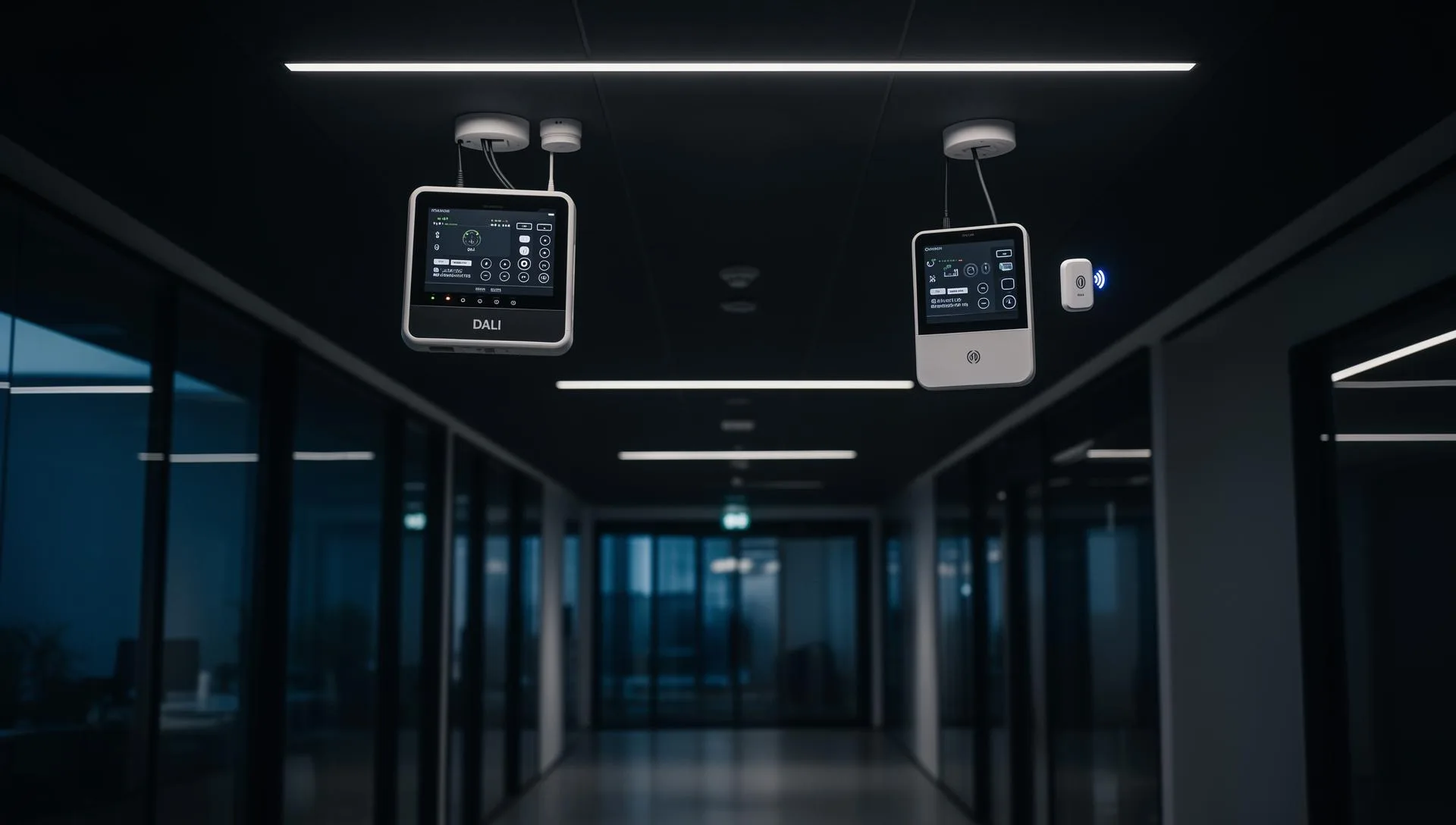
• Plexus™ sensors — compact wireless PIR and microwave occupancy sensors that communicate directly with luminaires on the mesh. Battery-powered options require no mains connection, enabling truly wireless sensor placement.
• Plexus™ switches — wireless wall switches and scene plates that replace traditional wired switches. Battery-powered with kinetic energy harvesting — no batteries to replace and no wiring required.
• Plexus™ app — iOS and Android commissioning application for grouping luminaires, assigning scenes, setting dimming profiles, configuring daylight harvesting and occupancy parameters. No specialist software or laptop required.
• Plexus™ gateway (optional) — for projects requiring BMS integration, remote monitoring or cloud-based analytics. The gateway bridges the Bluetooth Mesh to IP networks, enabling centralised control from a building management system.
All Plexus™ components are interoperable and backwards-compatible, meaning the system can be expanded incrementally as project requirements evolve.
Key Benefits of EOS Plexus™
• Retrofit-ready — the single biggest advantage. Intelligent lighting control in existing buildings without rewiring. Ideal for occupied refurbishments, listed buildings and ceiling void restrictions.
• Rapid commissioning — group luminaires, assign scenes and configure sensors in minutes via the smartphone app. Changes can be made post-occupancy without calling an electrician.
• Scalable — start with a single zone and expand across the building over time. No upfront infrastructure investment required.
• Energy savings — occupancy-based dimming, daylight harvesting and scheduled profiles deliver 40–60% energy reduction compared to static, always-on installations.
• Tuneable white support — Plexus™ drivers support DALI DT8 colour temperature control, enabling circadian lighting schedules via wireless commands.
• No single point of failure — the decentralised mesh architecture means no single controller or gateway failure can disable the lighting. Each luminaire operates independently if the mesh is interrupted.
• Interoperable — Bluetooth Mesh is an open, industry-standard protocol. Plexus™ components work alongside other Bluetooth Mesh-compliant devices.
• Reduced ongoing costs — software-based reconfiguration eliminates the cost of rewiring when tenants change, spaces are repurposed or operational needs evolve.
• UK support — EOS provides full technical support, commissioning assistance and training from our Harlow headquarters. We're not reselling a third-party system — Plexus™ is specified, tested and supported by EOS.
Wireless vs Wired: When to Use Each
Wireless Plexus™ is the right choice when: • Retrofitting controls into an existing building with no dedicated control wiring • The project is in an occupied building where disruption must be minimised • Heritage or listed building constraints prevent new cable routes • Phased installation is required — start with one floor, expand later • The client wants post-occupancy flexibility to reconfigure groups and scenes without rewiring • Budget constraints make full DALI wiring infrastructure unviable
Wired DALI-2 remains the right choice when: • New-build projects where control wiring is included in the electrical design from the outset • Very large installations (500+ luminaires) where wired infrastructure provides guaranteed bandwidth • Mission-critical environments (operating theatres, data centres) where hardwired reliability is non-negotiable • Full BMS integration is required from day one with real-time monitoring of every device
In many projects, a hybrid approach works best — wired DALI-2 for new-build core areas and wireless Plexus™ for retrofit zones, tenant fit-out areas or spaces likely to be reconfigured. EOS supports both protocols across our product range, giving specifiers complete flexibility.
Commissioning and Support
EOS provides comprehensive support for Plexus™ projects:
• Pre-project consultation — our controls team advises on system architecture, sensor placement and grouping strategy during the design phase • Commissioning assistance — on-site or remote support during initial system setup and configuration • Training — hands-on training for facilities teams on using the Plexus™ app for day-to-day scene changes and schedule adjustments • Post-occupancy fine-tuning — remote adjustment of sensor sensitivity, timeout periods and dimming profiles based on real-world occupancy patterns • Firmware updates — over-the-air (OTA) firmware updates ensure Plexus™ devices benefit from ongoing feature improvements and security patches
All Plexus™ products carry a minimum 5-year warranty, with UK-based technical support available throughout the product lifetime. Contact our team at hello@weareeos.com or 0203 633 4366 to discuss your project.
Related Pages
More Guides
What is DALI Lighting?
DALI (Digital Addressable Lighting Interface) is the global industry standard fo…
Tuneable White Lighting Guide
Tuneable white (also called tuneable CCT or human centric lighting) allows the c…
TM66 Circular Economy Lighting
TM66 is the CIBSE Technical Memorandum that provides a standardised method for a…
Lux Levels Guide
Lux is the standard unit of illuminance — the amount of light falling on a surfa…
IP Ratings Explained
IP (Ingress Protection) ratings classify the degree of protection a luminaire pr…
How to Light an Office
Never has the need for great office lighting been more imperative. This guide co…